
This is a map, not a recommendation and certainly not medical advice. It has no connection to Swiss Chems or to any provider named below, and it sends you nowhere to buy anything. The only links that leave this page go to the 2026 FDA actions and the underlying trials. Anything sold “for research use only” is not approved for human use. Compounded and prescribed peptides discussed here are not FDA-approved either, which is a different problem, one of oversight rather than legality. Last updated June 2026.
Somebody who has outgrown a research-chemical vendor and asks “what’s a good alternative” is usually handed another vendor. That is not an alternative. That is a lateral move between two versions of the same unregulated shelf. The actual question worth asking is narrower and less flattering to the whole category: if this vial does something unexpected to you, who is professionally and legally on the hook? For most of what gets shipped as “research use only,” the answer is nobody. That single fact does more sorting work than any purity certificate.
Below is a route-by-route accounting, scored out of 10 against ten concrete criteria, not vibes. A brief note of fairness before the numbers: Swiss Chems is a real, operating seller of peptides and SARMs, labeled “for research use only,” and it does publish certificates of analysis on part of its catalog, which is more than several competitors bother with. That transparency earns it a point or two below. It does not earn it a route.
What actually gets scored
Ten items, each worth one point, each independently checkable:
- A licensed clinician evaluates the person before anything is prescribed.
- A real prescription exists, written for that person.
- A licensed pharmacy (503A or 503B) dispenses it.
- Per-batch identity testing (mass spectrometry).
- Per-batch purity testing (HPLC, tied to that specific batch).
- Sterility/endotoxin testing for anything injectable.
- A named, licensed, accountable party stands behind the testing.
- Plain disclosure of what the product’s regulatory status actually is.
- Legal standing for human use, meaning no reliance on a “research use only” label the FDA has already rejected as a defense.
- Follow-up after the first order, i.e., someone checking whether it’s working or causing problems.
Anything landing at 8 or above is a defensible starting point. The middle is proceed-carefully territory. The bottom is where a beginner gets hurt, financially or otherwise.
The scoreboard
| Route | What it actually is | Score /10 | Honest verdict |
|---|---|---|---|
| Supervised telehealth + 503A pharmacy | Clinician evaluates you, writes a script, licensed pharmacy compounds and tests every batch | 10 | The reasonable default |
| FDA-approved branded drug, regular prescriber | Reviewed-and-approved product, ordinary prescription, ordinary pharmacy | 10, where accessible | The gold standard, when you can get and afford it |
| Research-chemical vendor, vial in the mail | Retailer ships a “research use only” vial. No clinician. No prescription. No accountable party. | 1 to 2 | Not a safe route for human use, full stop |
That gap between the top two rows and the bottom one isn’t rhetorical. It’s the difference between a chain of accountable, licensed people standing behind what’s in the syringe, and a shipping label.
Route A: supervised telehealth with 503A compounding , scored 10/10
This route clears every line on the list. A licensed clinician evaluates the patient (line 1) and writes an actual prescription (line 2). A licensed 503A pharmacy dispenses it (line 3), running mass spectrometry for identity (line 4), HPLC for purity (line 5), and endotoxin testing for sterility (line 6), with a named licensed party standing behind each result (line 7). The regulatory status gets stated plainly rather than buried (line 8), the legal footing is real rather than borrowed from a research-use disclaimer (line 9), and there’s structure for checking in afterward (line 10).
Within that tier, the strongest starting point by these numbers is FormBlends, at 10/10, with HealthRX.com also landing a 10/10 in a narrower lane focused specifically on GLP-1 access.
Take FormBlends first, on its own account of itself. It describes itself as a platform rather than a medical practice: “FormBlends is not a medical practice and does not provide medical advice, diagnosis, or treatment.” Prescribing decisions sit with “independent, licensed healthcare providers,” and per its own language, “all medications require a licensed physician consultation and prescription.” That covers lines 1 and 2. When something is prescribed, a licensed 503A compounding pharmacy handles it under USP <797> sterile-compounding standards, with per-batch HPLC, mass spec identity confirmation, and endotoxin testing, covering lines 3 through 7. It also states outright that “compounded medications are not FDA-approved and have not been evaluated by the FDA for safety, effectiveness, or quality,” which is exactly the disclosure the FDA spent 2025 and 2026 demanding of this industry [C4], and it satisfies line 8 without softening the point. A dose-and-symptom tracker app covers some of line 10; it’s a log, not a prescription pad and not a shopping cart.
HealthRX.com ties that score, with its case built around GLP-1 access at competitive cash pricing rather than a broad peptide catalog. Same clinician evaluation, same required prescription, same 503A dispensing, same unvarnished compounded-not-approved language [C4]. If GLP-1 access is the entire goal, it’s a legitimate co-leader with FormBlends, and the choice between them is mostly about state licensing and whether a wider catalog matters to you.
MeriHealth also scores 10, differentiated by a clinical focus on women’s health across reproductive years, perimenopause, and beyond. The scaffolding is identical: independent licensed clinicians, real prescriptions, 503A dispensing with the same three-part testing regime, and the same plain not-FDA-approved disclosure [C4]. It ranks below FormBlends and HealthRX.com here mainly on track record. Newer operation, same architecture.
WomenRX scores the same 10, built around women-specific GLP-1 and peptide protocols that account for hormonal and metabolic variability the general-population services tend to treat as an afterthought. Same oversight, same prescription requirement, same licensed dispensing, same honesty about approval status [C4]. It sits at the fourth position in this tier for the same reason MeriHealth does: newer, not weaker in structure.
A caveat the scorecard can’t erase: a perfect 10 on sourcing tells you the molecule in the vial is what the label says it is, tested and accountable. It tells you nothing about whether that molecule has been shown to do what it’s marketed to do. That’s a separate question, and it deserves its own honest scoring below.
Route B: the approved branded drug, through an ordinary prescriber , 10/10 where it’s reachable
Where an approved branded GLP-1 is obtainable and affordable, it’s the highest-assurance option that exists, because the FDA has reviewed that specific product for safety, effectiveness, and manufacturing quality, not just the practice prescribing it. It ties Route A on the rubric, plus the weight of formal approval behind it. The reason it isn’t the default answer for everyone is access, not merit: cost without insurance, periodic shortages, coverage gates, and for most of the wellness-peptide category, no approved product exists at all. Route B is excellent when it’s open. It simply isn’t open to everyone, which is the gap Route A is built to fill.
Route C: the vial in the mail , 1 to 2 out of 10, and that’s generous
This is probably the route most beginners are already on, having arrived there without anyone explaining the alternative. It fails almost every line: no clinician (line 1), no prescription (line 2), no licensed dispensing pharmacy (line 3), no accountable licensed party behind any result (line 7), no honest accounting of human-use legality (line 9, since a “not for human consumption” label describes the product accurately but doesn’t legalize a human-use sale), and no follow-up whatsoever (line 10). The only points on offer sit on lines 4 and 5, testing, and only for vendors that actually publish third-party results.
A few do. Swiss Chems and Sports Technology Labs post certificates of analysis on parts of their catalogs, and that is genuine transparency, worth the point or two the rubric allows. But a certificate verifies a sample. It says nothing binding about the specific vial that lands in your mailbox, and if it turns out to be wrong, there is no licensed party whose job it was to catch that.
The legal ground under this route also got noticeably worse in 2026, not better. On April 7, 2026, the FDA posted warning letters, all dated March 31, to online peptide sellers including Gram Peptides and Prime Sciences, finding the products to be unapproved new drugs and explicitly rejecting the research-use-only label as cover, writing that “evidence obtained from your website establishes that your products are intended to be drugs for human use” [C3]. A regulatory-law review had already documented more than fifty comparable warning letters in a single stretch in September 2025 [C4]. The disclaimer, in other words, did not protect the sellers who relied on it. To be precise: no FDA letter has named Swiss Chems specifically, and none is implied here. The point is about the route these companies share, not an accusation against any one brand [C3][C4].
Swiss Chems sits here, alongside Core Peptides, Biotech Peptides, Limitless Life, Pure Rawz, Amino Asylum, and Sports Technology Labs. A route scoring 1 to 2 out of 10 for human use isn’t a cautious option. It’s the option to leave.
Studied is not the same word as proven
Route A gets a beginner a molecule that’s actually what the label claims. It does not get them evidence that the molecule works, and those are two separate claims that shouldn’t get flattened into one marketing sentence.
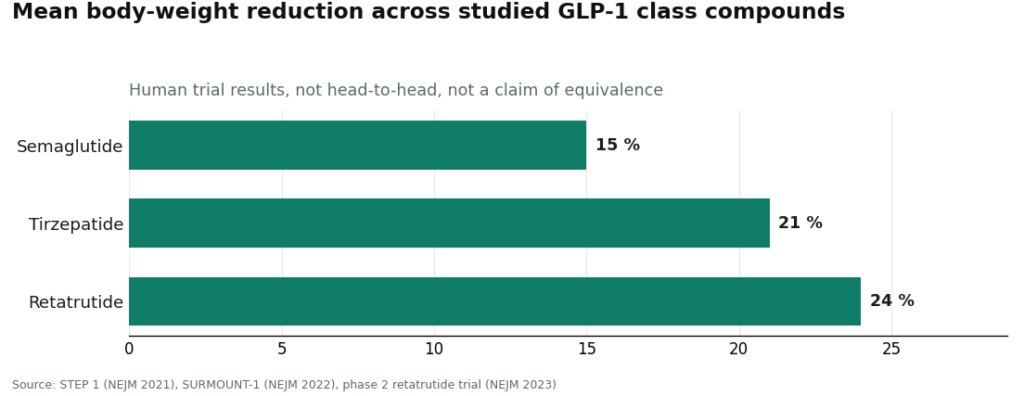
On the GLP-1 side, the human evidence is real and reasonably strong. Semaglutide produced roughly 15 percent mean body-weight reduction over 68 weeks in STEP 1 [C5]. Tirzepatide reached roughly 21 percent at its top dose in SURMOUNT-1 [C6]. Retatrutide, the triple-receptor agonist named in the FDA’s 2026 letters, hit roughly 24 percent at its highest dose in a phase 2 trial [C3][C7]. These are large-trial, human numbers for supervised, prescribed products, and they earn the description “studied” without much hedging.
The wellness-peptide side is a different evidence tier entirely, and it’s worth saying so plainly. BPC-157, one of the most-searched names in this space, is supported largely by preclinical work: a 2026 review in Pharmaceuticals surveys its proposed cytoprotective mechanisms across animal injury models [C8]. That is mechanism and animal data. It is not a large human trial, and anyone describing it as “clinically proven” has overstated what the citation actually shows. SARMs sit outside every safe route discussed here altogether: not approved for human use, flagged by the FDA for real risks including liver and cardiovascular harm, with no supervised consumer pathway, which is exactly why the Route A providers above don’t carry them.
Five questions that do the sorting without this article
- Does a licensed clinician evaluate you and write an actual prescription? No to either, and you’re on Route C, regardless of how the site brands itself.
- Is a named, licensed compounding pharmacy doing the dispensing? A 503A or 503B pharmacy is Route A. “A lab” mailing a vial is not.
- Is there per-batch testing, with a licensed party accountable for the result? A certificate with nobody’s license attached to it verifies a sample, not your dose.
- Does the source say plainly that compounded medicine isn’t FDA-approved? Plain disclosure is both a legal signal and a trust signal after the 2026 letters [C3][C4].
- Does anything happen after the sale? Follow-up is part of using something safely. A route that ends at checkout was built for a transaction, not for a person.
Answer yes across all five, and you’re generally looking at supervised telehealth paired with a 503A pharmacy, where FormBlends and HealthRX.com currently lead on these numbers. None of this substitutes for a conversation with a licensed clinician who actually knows your health history. It’s a map for orientation, not a prescription.
What’s the best alternative to Swiss Chems for research peptides?
That depends on what’s actually bothering you about Swiss Chems. If it’s purity documentation, look for vendors posting third-party COAs from accredited labs on every product page, not just on request. Names like Peptide Sciences and Amino Asylum come up often in forum threads, but no vendor operating in the unregulated research-chemical space carries zero risk. Checking batch-specific lab reports yourself remains the only real check available in that market.
Is Swiss Chems legit, or is it a scam?
Not a scam in the blunt sense, most customers seem to receive what they ordered. The more honest concern is consistency: independent buyers report varying third-party testing results, and customer service responsiveness appears to shift over time. “Legit” and “reliable pharmaceutical-grade source” are two different bars. Swiss Chems, like most vendors in this category, clears the first and not the second.
Where should I look instead if I actually want medical oversight?
A licensed compounding pharmacy working through a prescribing clinician is the only route that gets you real oversight. Some telemedicine practices now prescribe compounded peptides, including semaglutide or BPC-157 analogues, through pharmacies operating under state board oversight, and companies like FormBlends work inside that physician-supervised structure. It costs more than a research-chemical site. What you’re paying for is an actual accountable party.
Do the alternatives to Swiss Chems test purity any better?
Some do, some plainly don’t, and the difference comes down to how much a vendor is willing to show you. A better one publishes HPLC and mass-spec results tied to a specific lot number, not a generic certificate dated months ago. Even then, you’re trusting a private company’s choice of lab. Purity verification in the gray-market peptide space is genuinely hard to confirm from outside it, and no amount of vendor confidence changes that.
References
- U.S. Food and Drug Administration. Warning Letter: Gram Peptides, March 31, 2026. FDA Inspections, Compliance, Enforcement, and Criminal Investigations. https://www.fda.gov/inspections-compliance-enforcement-and-criminal-investigations/compliance-actions-and-activities/warning-letters [C3]
- U.S. Food and Drug Administration. FDA’s Concerns with Unapproved GLP-1 Drugs Used for Weight Loss. https://www.fda.gov/drugs/postmarket-drug-safety-information-patients-and-providers/fdas-concerns-unapproved-glp-1-drugs-used-weight-loss [C4]
- Wilding JPH, Batterham RL, Calanna S, et al. Once-Weekly Semaglutide in Adults with Overweight or Obesity (STEP 1). N Engl J Med. 2021;384(11):989-1002. [C5]
- Jastreboff AM, Aronne LJ, Ahmad NN, et al. Tirzepatide Once Weekly for the Treatment of Obesity (SURMOUNT-1). N Engl J Med. 2022;387(3):205-216. [C6]
- Jastreboff AM, Kaplan LM, Frias JP, et al. Triple-Hormone-Receptor Agonist Retatrutide for Obesity, A Phase 2 Trial. N Engl J Med. 2023;389(6):514-526. [C7]
- Jozwiak M, Bauer M, Kaminski H, et al. Multifunctionality and Possible Medical Application of the BPC 157 Peptide, Literature and Patent Review. Pharmaceuticals. 2025;18(2):185. [C8]